
03 Nov How Expert Retail POS Design Drives Shopper Engagement
In the modern tech-driven world, shoppers are getting more and more visually oriented. They look at and interact with things that visually appeal to them the most. In the world of retail, point-of-sale or POS designs can serve as an effective tool to drive shoppers’ attention. POS designs are basically visual cues like logos or other brand elements present in the store, that attract visitor attention, spark their curiosity and ultimately help drive their decision to purchase.
In this article we explore how expert POS design drives shopper engagement, the key elements that underpin successful implementations, and how 83 DPME (Design, Print, Marketing, Event & Exhibition) brings a refined yet effective approach to this space.
The Strategic Role of Retail POS Design
When a shopper walks into your store, they focus on things around them; color schemes, clear store layout, signage tone, and brand language are some of those elements. A well-executed POS environment can focus visitors’ attention on the right areas, eliminate friction points in the decision-making process and bolster brand presence. In 2025, the size of Singapore’s retail market is already estimated at USD 50.38 billion, with an expectation of further growth to USD 57.39 billion by 2030. Such a scenario designates the physical POS environment as a strategic tool to guide the behavior of a shopper.
Effective POS design takes into consideration not only the aesthetics, but also the psychology of movement and purchasing triggers. For instance, clear visibility of high-margin products, impulse zones near the checkout area and positive visual cues that positively impact purchase. By combining form and function, brands create an environment that says, in a very subtle way: “You belong here, you want this, now let’s make it easy.”
Services 83 DPME
83 DPME (Design, Print, Marketing, Event & Exhibition) offers a comprehensive suite of services to support retail POS design:
• Graphic Design – crafting visual identities, signage, merchandising displays.
• Print & Production – delivering high-quality prints, posters, stickers and marketing collaterals.
• Marketing & Campaign activation – aligning POS design with wider campaigns and shopper pathways.
• Event & Exhibition management – for brands launching new retail experiences or pop-ups.
Visual Cues that Elevate Shopper Engagement
In a retail context, visual cues serve as signposts. They direct attention, create emphasis and reinforce messaging. Color contrast, typographic hierarchy, lighting accents and interactive areas are some of the tools that a POS designer may use to grab shoppers’ attention. When appropriately combined, these indicators increase interaction, as they bring cognitive load down to a minimum and simplify the shopper with visual cues.
For example, a promotional sticker or shelf label that calls out “limited edition” or “new arrival” becomes more than decoration; it becomes a decision facilitator. When executed with precision, it becomes part of the brand experience and not just an afterthought. That’s where we see the power of sticker designs that drive sales come into play. Well-designed stickers are not just functional (identifying a product) but are strategic signals that convert interest into action.
Brand Identity at the Point of Sale
Brand consistency is important at every touchpoint – including the retail floor. If what was promised in your external branding doesn’t match the customer experience in-store, they may feel betrayed. The right POS design is a continuation of the brand narrative, in terms of materials, graphics and messaging. This is where logos that define your brand become important. A logo is a signature, but in a retail setting it must be incorporated into all the signage, to the merchandising displays, to the printed elements, so that the brand presence is unmistakable.
When the logo, typography and color palette carry through from exterior marketing to POS displays, the shopper senses cohesion. That sense of trust and familiarity reduces hesitation and increases comfort , a precursor to purchase. It’s not about plastering the logo everywhere; it’s about thoughtful integration so that brand identity becomes ambient but meaningful.
Environment & Flow: Designing for Movement
Shopper engagement is maximized when the environment and flow support exploration rather than interruption. At the POS level, this means arranging fixtures and displays so that the journey feels natural, and so that high-impact items are placed at strategic nodes. For example: entrance display → feature island → impulse center at checkout. Along this path, visual and brand cues reinforce the message.
Lighting, sight-lines and spacing are part of the equation. Overcrowded shelves confuse; too much blank space looks uninviting. The art is in a balanced layout. Expert POS design understands that engagement begins when the shopper feels guided, not manipulated, and when the physical space reflects the brand’s promise.
Print, Graphics & Material Quality
In a retail point of sale (POS) design, prints and graphics are the direct indicators of the branding and communication. The size of the poster, the quality of the shelf signage or the floor decals — all these materials are major in communicating the brand position. In a way, the use of long-lasting substrates, bright color reproduction, and skilled craftsmanship implies that the brand indeed cares – and the product gets to share that impression.
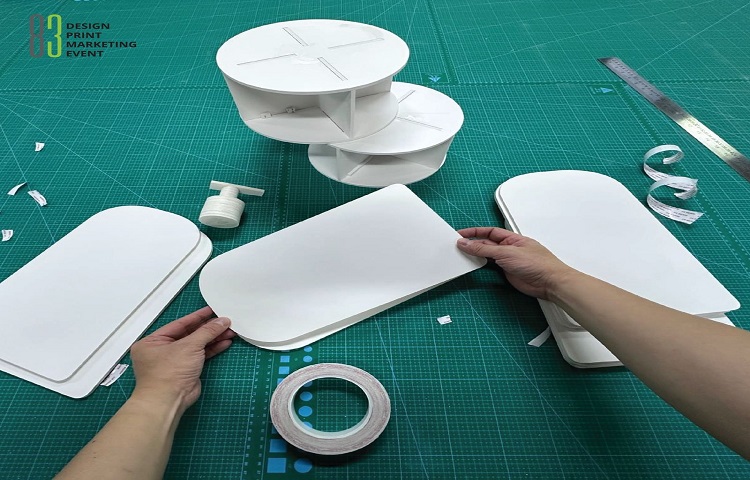
The craftsmanship behind every display element is just as important as the final design. As shown here, 83 Design’s team meticulously prototypes and assembles POS structures to ensure perfect alignment, stability, and finish before production. This hands-on precision guarantees that every piece, from cut edges to adhesive strength, reflects the brand’s quality promise and enhances the in-store experience.
Measuring Engagement & Iterating
Design without measurement is guesswork. For retailers, relevant indicators that they should track include dwell time at the displays, conversion rate uplift in POS areas, average basket size near high-impact displays and sales per square meter. This data can be used to iterate and make changes: change signage size, replace products, update messaging, etc. Over time, you develop a data-informed POS ecosystem that keeps optimizing shopper engagement.
Conclusion
In an ever-competitive retail environment, the design of your POS area is a strategic investment, not an aesthetic afterthought. Expert attention to visual cues, brand identity, environment flow and material quality transforms the retail floor from mere transaction space into an immersive brand experience. With the right partner you can create a retail environment that speaks to the shopper, invites engagement and drives purchase. If you’re ready to elevate your in-store presence, reach out to 83 DPME and let your brand narrative shine through every point of sale.

No Comments